

How To Connect Camera Button Onto Raspberry Pi 3
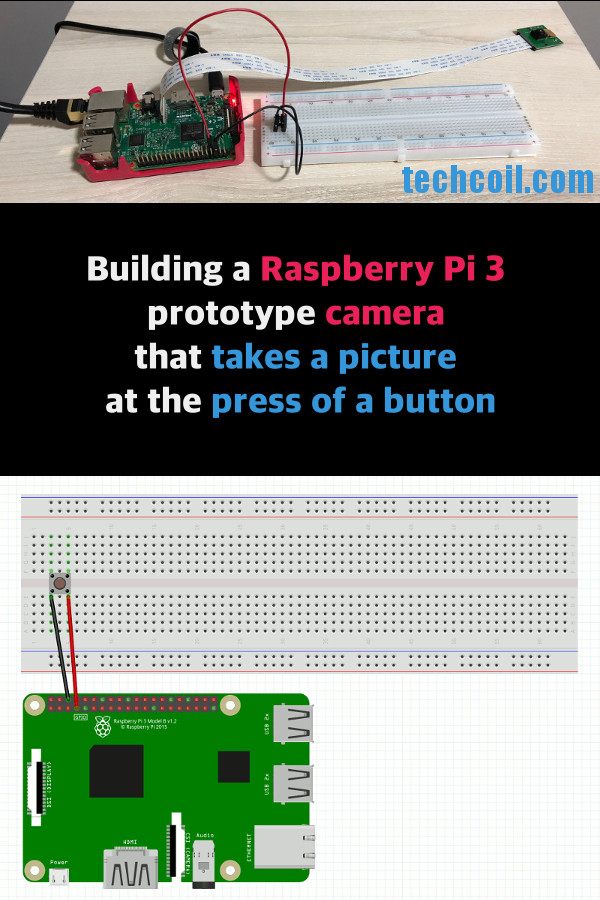
Building a Raspberry Pi 3 prototype camera that takes a picture at the press of a button
A fun way to test your Raspberry Pi Camera on your Raspberry Pi 3 is to build a image that takes a flick at the press of a push button. Through such an activeness, nosotros will be able to experience:
- connecting a button to the GPIO ports on a Raspberry Pi.
- setting up a camera through the CSI interface of a Raspberry Pi.
- preparing an operating organisation, such equally Raspbian Stretch Lite , for running Raspberry Pi projects.
- coding a Python iii script that interacts with the GPIO port and photographic camera on a Raspberry Pi.
- running a Python three script when Raspberry Pi powers on.
Given these points, this post shows how you tin build a Raspberry Pi 3 prototype camera that takes a picture at the press of a button.
Suggested neb of materials for this Raspberry Pi 3 projection
In case you need some reference on what you lot can buy for this Raspberry Pi 3 project, the post-obit is a suggested bill of materials for y'all:
- CanaKit Raspberry Pi 3 B+ (B Plus) with 2.5A Power Supply (UL Listed)
- Sandisk Ultra 32GB Micro SDHC UHS-I Menu with Adapter
- Raspberry Pi Camera Module V2 - 8 Megapixel,1080p
- A push, two male-to-female jumper wires and a breadboard from an electronic kit like REXQualis Electronics Component Fun Kit
- Official Raspberry Pi three Case - Ruddy/White (Optional)
Connecting the push button to the GPIO ports on your Raspberry Pi iii via the breadboard
For the purpose of this guide, permit's apply GPIO four and 1 of the ground pins of your Raspberry Pi 3 to find push presses. The following diagram shows how you tin wire the button button to a Raspberry Pi 3 via a breadboard:
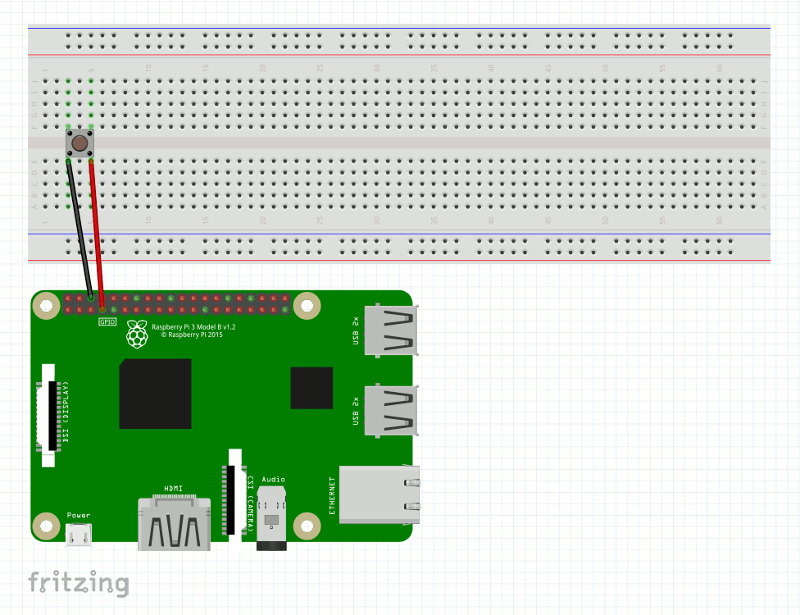
If you want to connect your push button push button to other GPIO pins on your Raspberry Pi 3, you tin can checkout these GPIO Pinout resource to assist you practice then.
How should the push exist inserted onto the breadboard
The following diagram shows a push button that is partially inserted:
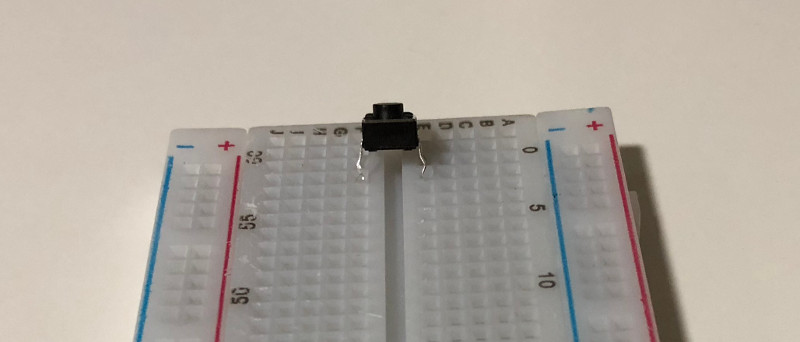
This is how the legs of the push be positioned when y'all insert it onto the breadboard.
Fully insert the push into the breadboard before continuing with the tutorial:
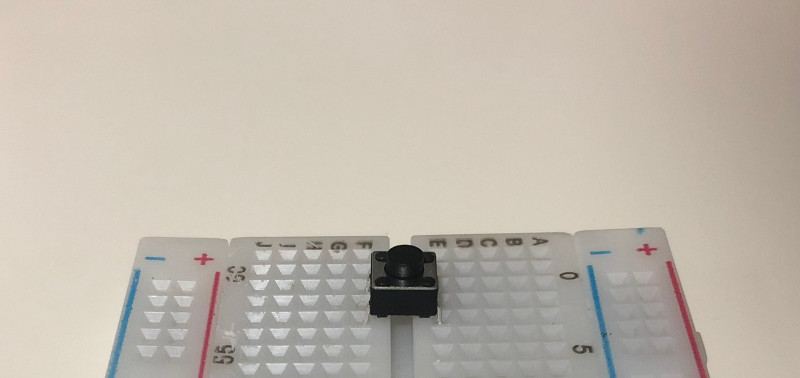
Connecting the Raspberry Pi Camera Module to your Raspberry Pi 3
After you had connected your button to your Raspberry Pi 3, proceed to connect the Raspberry Pi Camera Module to your Raspberry Pi three.
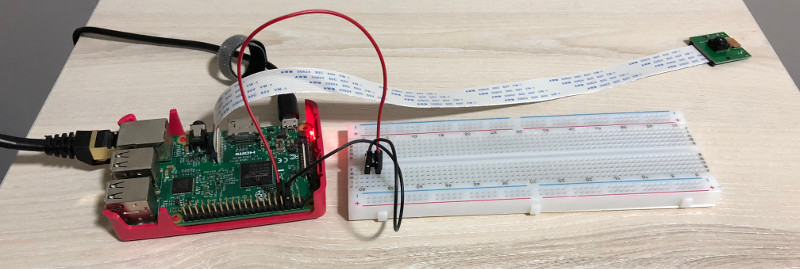
After connecting the Raspberry Pi Camera Module to your Raspberry Pi 3, your setup should look similar this:
Setting up Raspbian Stretch Lite with SSH server enabled on your microSD card
Once you lot had connected the camera and push to your Raspberry Pi iii, continue to setup Raspbian Stretch Lite with SSH server enabled on your microSD carte du jour. Doing so will allow you to SSH into your Raspbian Stretch Low-cal to perform further configurations in this post.
Starting the Raspbian Stretch Lite operating arrangement
Adjacent, connect one terminate of the RJ45 cable to the RJ45 port on the Raspberry Pi three board and the other cease of the cable to one of the switch port of your home router. Afterward that, connect the micro USB power supply to the Raspberry Pi 3 lath and a wall socket. Turn on the power socket to supply power to the Raspberry Pi iii lath.
Getting into Raspbian Stretch Light and updating it
After you had started your Raspbian Stretch Lite, SSH into your Raspberry Pi 3 with a computer that is connected to the same network every bit your Raspberry Pi 3.
Suppose your router had given your Raspberry Pi 3 192.168.ane.123 as the IP address, you lot will run the following control from your terminal program to get into Raspbian Stretch Lite:
ssh pi@192.168.ane.123
When Raspbian Stretch Calorie-free prompts for a password, enter raspberry.
Once you lot had gotten into Raspbian Stretch Lite, run the following control to update information technology:
sudo apt-get update
Enabling the camera on Raspbian Stretch Lite
Before we tin use the photographic camera on Raspbian Stretch Lite, we need to enable it. Therefore, follow this guide to enable Raspberry Pi Photographic camera on Raspbian Stretch Lite.
Installing Virtualenv on Raspbian Stretch Lite
Virtualenv is a tool that allows us to create isolated environments in the same machine. This is useful when you have to run multiple applications with conflicting python dependencies on your Raspberry Pi 3.
Therefore to exist able to use the same Raspberry Pi iii to try out other projects, nosotros volition exist using Virtualenv to create an environs to run our Python 3 script.
To install Virtualenv, run the post-obit command:
sudo apt-go install virtualenv -y
Installing Supervisor
When we desire our Python iii script to start at kicking time and constantly listen for push presses, we tin can use Supervisor to help us monitor and control the process that will run our Python iii script.
In order to install Supervisor, we need to run the following control:
sudo apt-get install supervisor -y
Coding a Python 3 script that interacts with the GPIO ports on a Raspberry Pi
After installing Supervisor, we can proceed to code a unproblematic Python 3 script that will:
- Heed for push button presses.
- Have a moving picture with the photographic camera when the push button is pressed.
Given these points, let'southward use nano to create a Python script at /home/pi/run.py:
nano /habitation/pi/run.py
Once the editor starts, copy the following Python three codes into the editor:
from gpiozero import Button from picamera import PiCamera from signal import pause import fourth dimension camera = PiCamera() def take_picture_with_camera(): image_path = '/home/pi/images/image_%s.jpg' % int(round(time.fourth dimension() * 1000)) photographic camera.capture(image_path) print('Took photo') push button = Button(four) button.when_pressed = take_picture_with_camera pause() After that, type Ctrl-Ten and then Y to relieve the file.
In the Python 3 script, nosotros get-go import the libraries that we are going to employ. After that, we create an example of PiCamera for interfacing with the Raspberry Pi Photographic camera module.
Python 3 codes to take picture with Raspberry Pi Camera
Once nosotros had created an case of PiCamera, we define a function: take_picture_with_camera.
Within take_picture_with_camera, we employ
-
time.time()to ascertain an image path to save the movie that the camera volition capture afterwards, -
camera.capture(image_path)to accept a film with the photographic camera and relieve the image to the path divers by image_path,
Python three codes to listen for push presses
Afterwards defining the function, nosotros went ahead to create an case of Push that will listen to voltage changes on GPIO 4.
Once we had created an instance of the button, we assign take_picture_with_camera to push button.when_pressed. Every bit a result of this, take_picture_with_camera will be called when the push push is pressed.
Finally, we pause the Python iii script to end it from terminating.
Creating a virtual surroundings to run the Python 3 script
Next, let's create a virtual environment to run the Python 3 script. In order to do so, nosotros volition run the post-obit command:
virtualenv -p python3 /home/pi/rpi-cam-epitome-env
After that, we become into the virtual surround by running the post-obit control:
source /home/pi/rpi-cam-image-env/bin/activate
Once you gotten into the virtual environment, run the following commands to install the Python dependencies for the Python three script:
pip install gpiozero==one.iv.1 picamera==1.thirteen RPi.GPIO==0.6.3
When pip finishes the installations, y'all will be able to run your Python 3 script within the virtual environment.
Testing your Python iii script
After you had prepared the virtual environment for your Python iii script, create the /habitation/pi/images binder:
mkdir /dwelling/pi/images
When the binder is created, run your Python script with the following commands:
cd /home/pi python run.py
You lot volition notice that subsequently you ran the commands, the last pauses. In addition, the LED on the Raspberry Pi Camera lights up. This indicates that your Python 3 script is set up to heed for push presses.
Given that, whenever you press the push, you will observe an image existence created inside the /home/pi/images folder.
Running the Python three script when your Raspberry Pi 3 powers on
When you lot want your Python 3 script to run whenever your Raspberry Pi 3 is turned on, you can depend on Supervisor. This department will testify how you can to get Supervisor to run your Python 3 script whenever your Raspberry Pi 3 is turned on.
Firstly, let'southward create a shell script that will activate the virtual environs that we had created before and run our Python 3 script within that virtual surroundings.
To do and then, we use nano to create a shell script at /habitation/pi/run.sh
nano /home/pi/run.sh
Once the editor loads, write the following content into the editor:
!#/bin/bash source ./rpi-cam-prototype-env/bin/activate python run.py deactivate
After yous had included the content, blazon Ctrl-X and so Y to save the file.
Afterwards, brand the vanquish script executable by running the post-obit command:
sudo chmod 744 /home/pi/run.sh
To get Supervisor to start our Python three script then that nosotros can take pictures with our Raspberry Pi 3 prototype, we first create a configuration file at /etc/supervisor/conf.d/rpi3-camera-prototype.conf:
sudo nano /etc/supervisor/conf.d/rpi3-camera-epitome.conf
Afterward nano loads, copy the following configuration codes into the editor:
[program:rpi3-camera-paradigm] directory=/home/pi command=/bin/bash -Due east -c ./run.sh autostart=true autorestart=truthful stopsignal=INT stopasgroup=true killasgroup=truthful user=pi
In one case yous had written the configurations into the editor, run the post-obit command to restart Supervisor:
sudo systemctl restart supervisor.service
When Supervisor runs once again, it will take the configurations that you had created earlier and run your Python 3 script.
With that, whenever yous power on your Raspberry Pi three, you volition be able to take pictures with your Raspberry Pi photographic camera by pushing the push button.
Further enhancement: Perform image compression on the pictures from your Python iii script
You may accept noticed that the images that you lot Raspberry Pi camera took are pretty large, each of them takes more than than 150 KB.
In instance you are extending the prototype to send the pictures to a server endpoint, you may want to shrink the pictures earlier sending it, peculiarly when yous connect your Raspbian Stretch Light to your iPhone Personal WiFi hotspot.
In such a situation, you may want to apply Python 3 Pillow on Raspbian Stretch Calorie-free to compress your jpeg images.
To keep this tutorial brusque, I will leave it to y'all to figure out how to modify the Python 3 script to compress your pictures with Pillow.

Source: https://www.techcoil.com/blog/building-a-raspberry-pi-3-prototype-camera-that-takes-a-picture-at-the-press-of-a-button/
Posted by: vecchionothembeffe.blogspot.com
0 Response to "How To Connect Camera Button Onto Raspberry Pi 3"
Post a Comment